



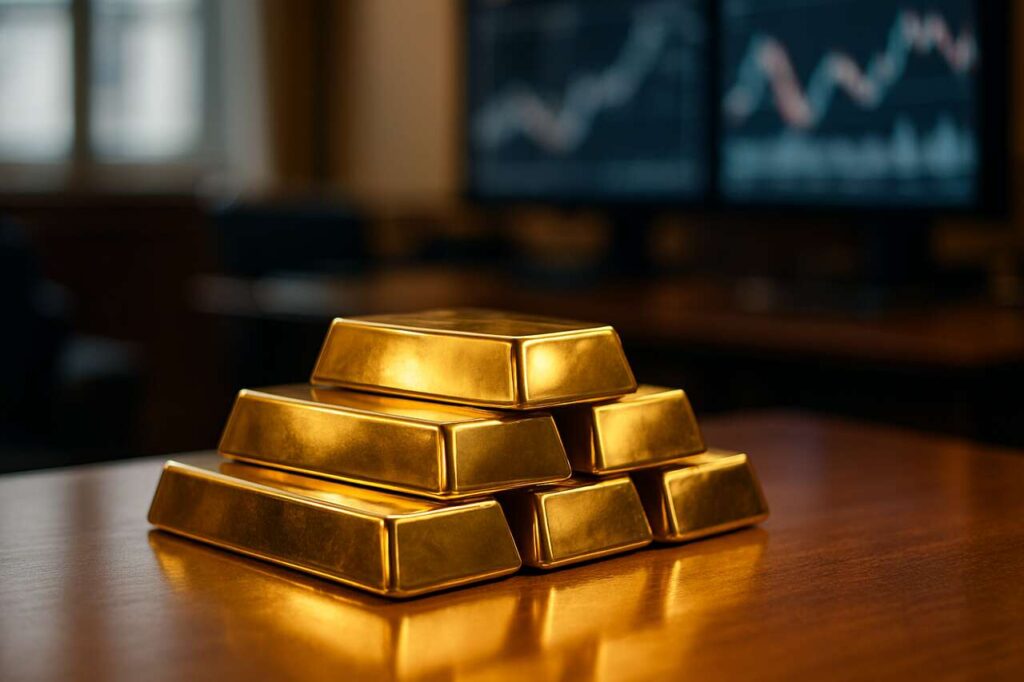
The price of gold has surged to unprecedented levels, breaking through the symbolic barrier of 5,000 USD per ounce in early 2026. This milestone represents more than a simple market fluctuation driven by short-term anxieties. Rather, it signals a fundamental shift in how investors perceive the stability of the global financial system. While recent geopolitical tensions and inflationary pressures have certainly contributed to this rise, the underlying causes reveal a far more troubling picture of eroding confidence in the institutions that underpin modern economies.
Understanding the growing allure of gold
The historical role of gold as a store of value
Gold has served humanity as a reliable store of value for millennia, long before the advent of paper currencies or digital transactions. Its intrinsic properties make it uniquely suited to this role:
- durability and resistance to corrosion
- scarcity and difficulty of extraction
- universal recognition across cultures and borders
- divisibility and portability in various forms
Unlike fiat currencies, which derive their value from government decree and public trust, gold possesses tangible physical properties that cannot be manipulated through monetary policy or political decisions. This fundamental difference explains why investors consistently turn to precious metals during periods of uncertainty.
Recent market dynamics driving demand
The doubling of gold prices throughout 2025 was not an isolated phenomenon but rather the culmination of several converging trends. Central bank purchases reached record levels as monetary authorities sought to diversify their reserves away from traditional currencies. Simultaneously, retail investors increased their allocations to physical gold and gold-backed securities, reflecting widespread concerns about the sustainability of current economic policies.
The acceleration of this trend into 2026 demonstrates that the appetite for gold extends beyond temporary market jitters. It represents a structural shift in portfolio allocation that suggests deeper anxieties about the future of monetary systems. This growing demand sets the stage for examining how gold functions specifically during times of economic turbulence.
The role of gold in the face of economic instability
Gold as a hedge against volatility
Financial markets have experienced extraordinary volatility in recent years, with sudden swings in equity valuations, bond yields, and currency exchange rates becoming increasingly common. In this environment, gold has demonstrated its capacity to serve as a stabilising force within diversified portfolios. Statistical analysis shows that gold typically exhibits low or negative correlation with traditional asset classes during periods of market stress.
| Economic condition | Typical gold performance | Equity market performance |
|---|---|---|
| High inflation | Strong gains | Declining or stagnant |
| Currency devaluation | Appreciating value | Variable |
| Geopolitical crisis | Safe-haven demand increases | Sharp declines |
The psychological dimension of gold ownership
Beyond its mathematical properties as a portfolio diversifier, gold ownership provides investors with a psychological anchor during turbulent times. The ability to hold a physical asset that retains value independently of government promises or corporate performance offers reassurance that paper-based investments cannot match. This emotional component, whilst difficult to quantify, plays a significant role in driving demand during periods of heightened anxiety about economic prospects.
The protective qualities of gold during instability naturally lead to questions about what investors are protecting themselves against, particularly regarding the currencies they use daily.
Trust in fiat currencies questioned
The erosion of monetary credibility
The concept of monetary credibility refers to the public’s confidence that central banks will maintain the purchasing power of their currencies over time. This credibility rests on several pillars:
- consistent control of inflation within stated targets
- prudent management of public debt levels
- independence from political interference
- transparent communication of policy objectives
Recent years have witnessed significant challenges to these pillars. Prolonged periods of unconventional monetary policy, including quantitative easing programmes and negative interest rates, have raised concerns about the long-term consequences of such interventions. The expansion of central bank balance sheets to unprecedented levels has prompted questions about whether these institutions can successfully reverse course without triggering financial instability.
Currency debasement concerns
The massive fiscal stimulus programmes implemented in response to various crises have resulted in substantial increases in money supply across major economies. Whilst these measures may have been necessary to prevent economic collapse, they have also fuelled concerns about currency debasement. Investors increasingly worry that the purchasing power of their savings will be eroded through inflation, prompting them to seek alternatives that cannot be created at will by government authorities.
Gold’s fixed supply makes it an attractive alternative to currencies that can be expanded through policy decisions. This fundamental scarcity underpins its appeal as governments face increasingly difficult choices in managing their economies.
Governments’ tough choices battling inflation
The policy trilemma facing authorities
Governments and central banks find themselves confronting an impossible trinity of objectives that cannot be simultaneously achieved. They must choose between:
- controlling inflation through restrictive monetary policy
- supporting economic growth and employment
- maintaining manageable debt service costs
Raising interest rates to combat inflation increases the cost of servicing government debt and risks triggering recession. Maintaining low rates to support growth allows inflation to persist, eroding purchasing power. This dilemma has no easy resolution, and the policy uncertainty it creates drives investors towards assets like gold that offer protection regardless of which path authorities choose.
Political pressures and policy constraints
The challenge of addressing inflation is compounded by political realities that constrain policymakers’ options. Electorates accustomed to low interest rates and expansive government spending may resist the austerity measures necessary to restore price stability. This political dimension adds another layer of uncertainty to the economic outlook, further justifying the appeal of gold as an insurance policy against policy mistakes or political paralysis.
As governments struggle with these challenges, sophisticated investors are adapting their strategies to navigate the uncertain landscape ahead.
Wealthy investors and new strategies around gold
Institutional adoption of gold allocations
Major institutional investors, including pension funds, sovereign wealth funds, and family offices, have substantially increased their strategic allocations to gold in recent years. This shift reflects a recognition that traditional portfolio construction models may be inadequate for the current environment. Many institutions now maintain permanent gold positions ranging from five to fifteen per cent of their total assets, representing a significant departure from historical norms.
Diversification beyond physical holdings
Whilst physical gold remains popular, wealthy investors have access to a broader range of gold-related investments:
- gold mining equities offering leverage to price movements
- exchange-traded funds providing convenient exposure
- gold futures and options for tactical positioning
- allocated storage accounts in secure jurisdictions
This diversification allows investors to tailor their gold exposure to specific objectives, whether seeking price appreciation, income generation, or simply wealth preservation. The sophistication of these strategies underscores that the current gold rally is driven by informed decision-making rather than panic buying.
The record gold price ultimately reflects a comprehensive reassessment of risk across the global financial system. Investors are signalling through their actions that they perceive fundamental weaknesses in the structures that have supported economic growth for decades. Whether this loss of confidence proves justified or excessive will only become clear with time, but the message embedded in gold’s ascent cannot be ignored by policymakers or market participants. The precious metal’s surge serves as both a symptom of deeper problems and a potential harbinger of further challenges ahead for economies struggling to balance competing imperatives in an increasingly complex world.