

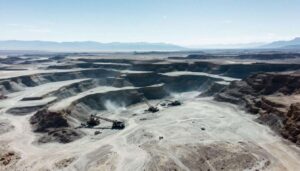


The announcement of a massive gold deposit discovery in China’s Hunan province has sent ripples through the global mining sector. Geological authorities revealed that this extraordinary find, buried approximately 2,000 metres beneath the surface, could contain reserves exceeding 1,000 tonnes of gold. With an estimated value surpassing US$80 billion, this supergiant deposit represents one of the most significant mineral discoveries in recent decades. The timing of this revelation coincides with gold prices hovering near historic peaks, amplifying the economic and strategic importance of this find for both China and the international commodities market.
Discovery of a “supergiant” deposit in China
Geological characteristics and location
The deposit, situated in Hunan province, extends deep into the earth’s crust at depths reaching 2,000 metres. Geological surveys have identified more than 40 distinct mineral veins within the site, demonstrating the complexity and scale of this underground treasure. Initial assessments confirmed reserves of 300 tonnes of gold, whilst projections suggest the total deposit could harbour between 1,000 and 1,100 tonnes, making it one of the largest gold concentrations ever documented.
Advanced exploration techniques
The discovery showcases the remarkable progress in deep mining exploration technology. Chinese geological teams employed sophisticated surveying methods to penetrate previously inaccessible depths, revealing mineral wealth that remained hidden for millennia. This technical achievement underscores China’s growing capabilities in mineral prospecting and positions the nation at the forefront of modern geological exploration.
The sheer magnitude of this discovery naturally leads to questions about its financial implications and how it might reshape economic landscapes both domestically and internationally.
Economic value and financial implications
Valuation in current market conditions
With gold prices maintaining elevated levels, the deposit’s estimated value reaches approximately 600 billion yuan, equivalent to roughly US$83 billion. This valuation reflects current market conditions and assumes successful extraction of the projected reserves. The financial scale of this discovery positions it amongst the most valuable mineral assets globally.
Strategic importance for China
As the world’s leading gold producer, China stands to consolidate its dominance through this discovery. The deposit offers several strategic advantages:
- Enhanced domestic resource security and reduced dependency on imports
- A powerful hedge against global market volatility and currency fluctuations
- Strengthened position in international gold trading and pricing mechanisms
- Increased national reserves to support monetary policy objectives
These economic considerations extend beyond China’s borders, affecting how the global mining sector positions itself for future developments.
Impact on the global mining industry
Comparative analysis with existing deposits
If projections prove accurate, this Chinese discovery could eclipse some of the world’s most renowned gold deposits. The following comparison illustrates its potential significance:
| Deposit | Location | Estimated reserves (tonnes) |
|---|---|---|
| Hunan supergiant deposit | China | 1,000-1,100 |
| South Deep | South Africa | 900 |
Market dynamics and investor sentiment
The announcement has generated considerable excitement amongst mining companies and investors. However, some analysts maintain a cautious stance, questioning both the scale and economic viability until independent verification confirms the estimates. This scepticism reflects the industry’s awareness that geological projections do not always translate into commercially viable operations.
Beyond market reactions, the practical realities of accessing and processing such vast quantities of gold present formidable obstacles.
The challenges of extracting gold in large quantities
Technical complexities of deep mining
Extracting gold from depths of 2,000 metres introduces substantial technical challenges. Deep mining operations require sophisticated ventilation systems, temperature management solutions, and structural support mechanisms to ensure worker safety and operational efficiency. The pressure and heat at such depths complicate drilling and extraction processes significantly.
Infrastructure and investment requirements
Developing a deposit of this magnitude demands considerable financial investment and infrastructure development:
- Construction of advanced mining facilities capable of deep-earth operations
- Implementation of ore processing plants with sufficient capacity
- Development of transportation networks for equipment and extracted materials
- Recruitment and training of specialised personnel
- Establishment of safety protocols and emergency response systems
These operational considerations intersect with growing concerns about the ecological footprint of large-scale mining activities.
Environmental consequences
Ecological risks of deep mining
Large-scale gold extraction inevitably carries environmental implications. Deep mining operations can trigger ground subsidence, alter underground water systems, and generate substantial quantities of waste rock. The processing of gold ore typically involves chemical treatments that, if improperly managed, pose risks to surrounding ecosystems and water sources.
Sustainability and regulatory frameworks
China faces increasing pressure to balance economic development with environmental protection. The exploitation of this deposit will test the effectiveness of regulatory mechanisms designed to minimise ecological damage. Sustainable mining practices, including waste management protocols, water treatment systems, and habitat restoration programmes, will prove essential to mitigating negative environmental impacts.
The environmental dimension represents just one facet of the broader geopolitical ramifications stemming from this discovery.
Global geopolitical repercussions
Shift in commodity power dynamics
Control over such substantial gold reserves enhances China’s influence in international commodity markets. This discovery strengthens the nation’s negotiating position in trade discussions and provides additional leverage in economic diplomacy. The concentration of gold production capacity within Chinese territory may prompt other nations to reassess their resource security strategies.
Currency and reserve implications
Gold remains a critical component of national reserves and monetary systems worldwide. China’s expanded access to domestic gold supplies could influence its approach to currency management and international financial arrangements. The deposit may also affect global gold pricing mechanisms, particularly if production volumes increase substantially once extraction commences.
The announcement of this supergiant gold deposit in Hunan province represents a potentially transformative development for the global mining sector. Whilst the estimated value exceeding US$80 billion captures immediate attention, the long-term implications extend across economic, technological, environmental, and geopolitical domains. The realisation of this deposit’s full potential depends upon successful navigation of technical extraction challenges, environmental stewardship, and market conditions. Independent verification of reserve estimates will prove crucial in determining whether this discovery truly ranks amongst history’s greatest mineral finds.