



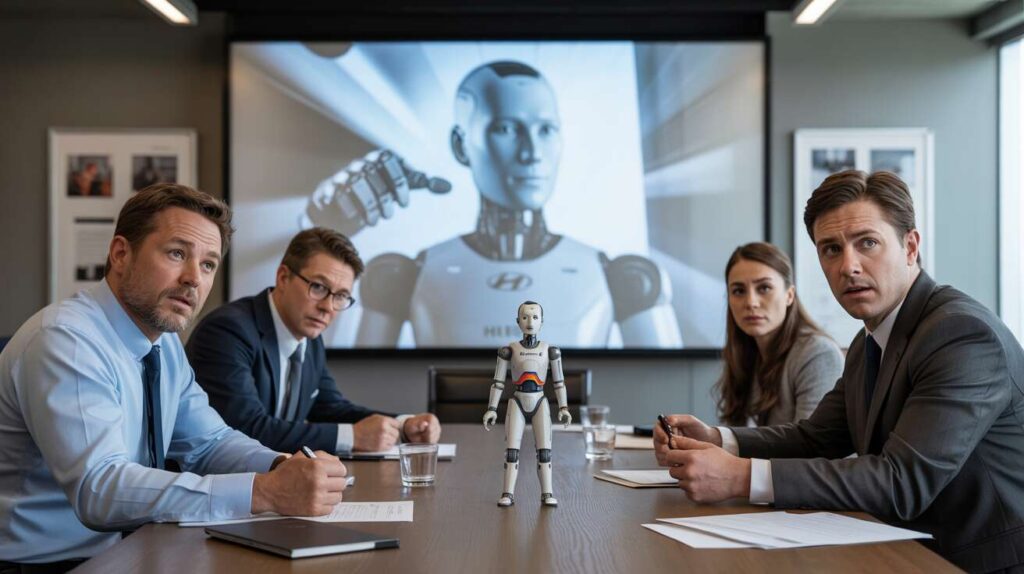
The rise of advanced robotics in manufacturing has reached a critical juncture at Hyundai, where the company’s labour union has issued a stark warning about the potential consequences of introducing humanoid robots into production facilities. This confrontation between technological progress and workforce protection highlights the growing tensions within the automotive industry as companies pursue automation strategies whilst workers fear for their livelihoods. The union’s categorical refusal to permit any robotic deployment without formal agreements underscores the depth of concern amongst employees who see their jobs potentially threatened by machines.
Hyundai union on alert over humanoid robots
A firm stance against unilateral deployment
The Hyundai motor workers’ union has adopted an uncompromising position regarding the introduction of humanoid robots within the company’s facilities. In a statement issued on a Thursday in late January, the union made its position abundantly clear: no robot will be permitted on work premises without a comprehensive agreement between union representatives and management. This declaration represents more than mere rhetoric; it signals a fundamental challenge to Hyundai’s automation ambitions.
The catalyst for this confrontation was Hyundai’s announcement of its intention to showcase the humanoid robot Atlas, developed by its subsidiary Boston Dynamics, at the Consumer Electronics Show in Las Vegas. This revelation has transformed what might have been a technological milestone into a flashpoint for labour relations. The union’s response demonstrates:
- A determination to maintain control over workplace changes
- Recognition of the existential threat posed by automation
- Willingness to confront management over technological decisions
- Insistence on formal negotiation processes before implementation
The union’s alert status reflects broader anxieties about how rapidly advancing robotics could reshape the automotive manufacturing landscape, potentially rendering human workers obsolete in roles they have occupied for decades.
Union concerns about the future of employment
Economic calculations driving automation fears
At the heart of the union’s opposition lies a stark economic reality that cannot be ignored. The financial comparison between human workers and humanoid robots reveals why employees feel threatened. According to available data, annual maintenance costs for a humanoid robot stand at approximately 9,500 dollars, a figure dramatically lower than the annual wage costs associated with human workers when benefits, insurance, and other employment expenses are factored into the equation.
| Cost factor | Humanoid robot | Human worker |
|---|---|---|
| Annual operational cost | $9,500 | Significantly higher |
| Working hours | 24/7 potential | Limited shifts |
| Consistency | Uniform performance | Variable |
The scale of potential displacement
The union’s concerns are magnified by the ambitious scale of Hyundai’s robotisation plans. The company intends to construct a facility capable of producing 30,000 humanoid robot units annually by 2028. This production capacity suggests not merely experimental deployment but a fundamental transformation of manufacturing operations. Workers understand that such numbers could translate into thousands of jobs at risk across multiple facilities.
These employment concerns extend beyond immediate job losses to encompass questions about career progression, skill relevance, and the very nature of work in automotive manufacturing. The union’s vigilance stems from recognition that once automation begins, it rarely reverses course.
Hyundai’s robotisation plans at the heart of tensions
Strategic deployment across facilities
Hyundai’s automation strategy follows a methodical expansion pattern that amplifies union anxieties. The initial deployment targets the company’s Georgia plant, with plans for gradual expansion to other production sites subsequently. This phased approach suggests a long-term commitment to robotisation rather than limited experimentation, making the stakes considerably higher for the workforce.
The choice of the Georgia facility as the testing ground carries particular significance. As a relatively modern plant, it may offer infrastructure better suited to robotic integration, potentially serving as a template for broader implementation. Workers at other facilities observe developments in Georgia knowing their own positions may soon face similar scrutiny.
Management’s efficiency objectives
From Hyundai’s perspective, the robotisation programme represents a pathway to enhanced productivity and competitiveness. The company’s objectives likely include:
- Reducing long-term labour costs
- Improving manufacturing consistency and quality
- Increasing production flexibility
- Maintaining competitiveness against rivals pursuing similar automation
- Addressing potential future labour shortages
However, the union contends that these efficiency gains come at an unacceptable human cost, particularly when implemented without adequate consultation or protection for displaced workers. This fundamental disagreement about priorities fuels the ongoing tensions between management and labour representatives.
Protests against the deployment of robots in factories
Demands for formal frameworks
The union’s opposition manifests not merely as resistance to technology itself but as insistence on proper procedural safeguards before implementation. Labour representatives demand that management establish formal frameworks addressing employee concerns before introducing technologies that may impact employment. This requirement encompasses several key elements:
- Transparent communication about automation plans and timelines
- Genuine consultation with worker representatives
- Binding agreements on job protection measures
- Commitments regarding retraining and redeployment opportunities
- Mechanisms for ongoing dialogue as technology evolves
These demands reflect a pragmatic recognition that outright prevention of automation may prove impossible, but that workers deserve meaningful participation in decisions affecting their futures.
Broader implications for labour relations
The confrontation at Hyundai carries significance beyond the immediate parties involved. Other automotive manufacturers closely monitor this dispute, recognising that similar conflicts may emerge at their own facilities as robotics technology advances. The precedents established through this confrontation could influence labour negotiations across the industry, making the outcome consequential for workers and management teams throughout the automotive sector.
The call for coexistence between workers and robots
Alternative perspectives on technological transition
Amidst the polarised positions of union opposition and management ambition, alternative voices advocate for more nuanced approaches. A director at the International Labour Organization has called for coexistence between workers and robots, suggesting that outright resistance may prove counterproductive. This perspective acknowledges technological inevitability whilst emphasising the need for managed transitions that preserve meaningful roles for human workers.
The coexistence model proposes several strategies:
- Comprehensive training programmes enabling workers to operate alongside robots
- Redeployment of employees to roles requiring human judgment and adaptability
- Creation of new positions focused on robot supervision and maintenance
- Gradual implementation allowing workforce adjustment over time
Historical patterns of technological resistance
Observers note that resistance to new technologies represents a classic reaction throughout industrial history. Previous technological revolutions prompted similar fears, yet labour markets eventually adapted, albeit often painfully for workers caught in transitions. This historical perspective suggests that whilst concerns about robotisation are legitimate, complete prevention may neither be possible nor ultimately beneficial if proper support mechanisms exist.
The challenge lies in ensuring that this transition does not simply replicate past patterns where workers bore disproportionate costs whilst benefits accrued primarily to ownership and management.
Debates in Korea on automation and employment
National context for labour disputes
The Hyundai confrontation unfolds against a broader backdrop of national debates regarding automation and employment within Korea. As a technologically advanced economy with strong manufacturing traditions, Korea faces particular tensions between embracing innovation and protecting workforce stability. The automotive industry occupies a central position in these debates, given its economic importance and the scale of employment it provides.
Global automotive industry trends
Korean debates mirror concerns resonating throughout the global automotive industry. Manufacturers worldwide pursue automation solutions to improve efficiency, yet face growing scrutiny regarding employment impacts. The balance between technological progress and social responsibility remains elusive, with different companies and countries adopting varying approaches. Hyundai’s experience may offer lessons applicable far beyond Korea’s borders as the industry collectively grapples with automation’s human dimensions.
The confrontation between Hyundai’s labour union and management encapsulates fundamental tensions emerging as humanoid robotics technology matures. The union’s categorical opposition to deployment without formal agreements reflects legitimate concerns about massive job losses, particularly given the stark cost advantages robots offer and the ambitious scale of planned production. Whilst perspectives advocating coexistence between workers and robots offer potential pathways forward, the immediate standoff underscores how technological progress can collide with workforce protection imperatives. As debates continue within Korea and across the global automotive industry, the outcome of this dispute may establish important precedents for managing automation’s impact on employment in manufacturing sectors increasingly tempted by robotic solutions.