



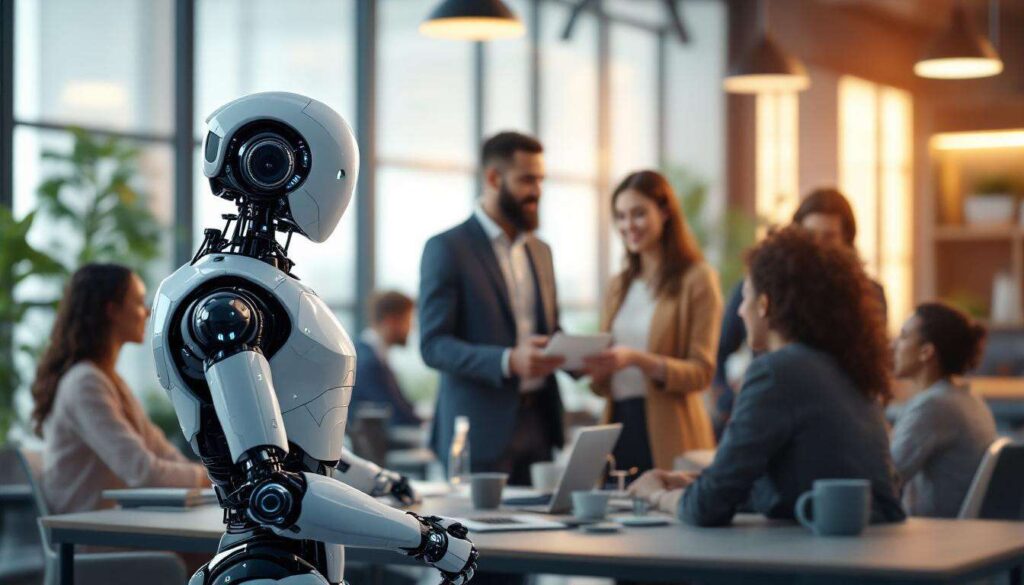
Organisations across industries are witnessing a profound shift in how teams are managed and supervised. Artificial intelligence has evolved from a simple automation tool to a sophisticated system capable of analysing performance, coordinating tasks, and even making decisions traditionally reserved for human supervisors. This technological evolution raises fundamental questions about the nature of leadership and the future structure of corporate hierarchies. As businesses increasingly adopt intelligent systems to streamline operations and enhance productivity, the prospect of reporting to an algorithm rather than a person becomes less science fiction and more workplace reality.
The rise of artificial intelligence in management
Technological capabilities driving the change
Artificial intelligence has developed remarkable competencies that position it as a viable candidate for managerial responsibilities. These systems demonstrate exceptional abilities in three critical areas: cognition, where they process vast quantities of data at speeds impossible for humans; reasoning, through sophisticated analytical frameworks that identify patterns and correlations; and coordination, managing multiple concurrent operations with precision. Assembly line environments have already benefited from AI-driven risk assessments, whilst space exploration projects utilise intelligent systems to handle complex calculations and scenario planning.
Corporate adoption patterns
Businesses are increasingly integrating AI into their management structures to address specific operational challenges. Recent implementations reveal several key applications:
- Marketing strategy optimisation through predictive analytics
- Energy consumption management and sustainability initiatives
- Enhanced problem-solving capabilities across departments
- Real-time performance monitoring and feedback systems
Insurance providers have deployed AI software to deliver immediate feedback to customer service representatives, resulting in a 13% improvement in customer satisfaction metrics. This approach addresses the preferences of younger workers who favour continuous evaluation over traditional annual appraisals, fundamentally altering the rhythm and nature of performance management.
These developments naturally lead to examining what specific competencies AI brings to supervisory roles.
The key skills of an AI manager
Data-driven decision making
AI managers excel at objective analysis, removing emotional bias from personnel decisions. They evaluate performance metrics consistently, applying identical standards across all team members without favouritism or prejudice. This capability ensures fairness in assessments, promotions, and resource allocation based purely on quantifiable outcomes and established criteria.
Continuous monitoring and feedback
Unlike human supervisors constrained by time and attention, AI systems provide constant oversight and immediate responses. They track productivity indicators in real-time, identify deviations from expected performance, and deliver corrective guidance instantly. This perpetual availability addresses the modern workforce’s demand for frequent communication and swift resolution of queries.
Resource optimisation
Intelligent management systems demonstrate superior capacity for task allocation and workflow coordination. They analyse individual strengths, current workloads, and project requirements to distribute assignments efficiently. By processing multiple variables simultaneously, AI managers maximise team output whilst minimising bottlenecks and redundancies.
| Management skill | AI capability level | Primary advantage |
|---|---|---|
| Performance analysis | Exceptional | Objective, data-based evaluation |
| Task coordination | Superior | Multi-variable optimisation |
| Availability | Continuous | 24/7 support and monitoring |
| Consistency | Perfect | Uniform standards application |
Understanding these strengths provides context for comparing AI with conventional leadership approaches.
AI vs traditional managers: what are the differences ?
Emotional intelligence and empathy
Human supervisors possess emotional awareness that remains beyond current AI capabilities. They recognise subtle cues in body language, tone, and behaviour that signal personal difficulties, stress, or dissatisfaction. Traditional managers adapt their communication style to individual personalities, provide emotional support during challenging periods, and build relationships based on trust and mutual understanding. AI systems, despite sophisticated programming, cannot genuinely empathise or respond to the nuanced emotional needs of team members.
Flexibility and contextual judgement
Experienced human leaders exercise discretionary judgement, considering circumstances that fall outside standard parameters. They make exceptions when warranted, recognise when rules should bend, and understand the broader organisational culture. AI managers operate within programmed boundaries, applying algorithms consistently but potentially missing context-dependent factors that require human wisdom and experience.
Innovation and creative problem-solving
Traditional managers contribute original thinking and unconventional solutions to unprecedented challenges. They draw upon diverse experiences, intuition, and lateral thinking to navigate ambiguous situations. Whilst AI excels at pattern recognition within existing data, it struggles with truly novel scenarios requiring imaginative approaches or paradigm shifts.
These distinctions highlight how AI integration reshapes workplace dynamics and employee experiences.
The impacts on the workplace
Changes to employee autonomy
AI-driven management introduces heightened surveillance that fundamentally alters the employee experience. Continuous monitoring can create pressure and anxiety, as workers feel constantly observed and evaluated. Retail and logistics operations have faced criticism for implementing tracking systems that measure productivity with such granularity that employees report feeling dehumanised and mistrusted.
Shifts in workplace culture
The introduction of algorithmic supervisors modifies organisational culture in several ways:
- Reduced informal interactions and spontaneous collaboration
- Increased focus on measurable outputs over qualitative contributions
- Diminished opportunities for mentorship and professional development
- Changed communication patterns favouring data over dialogue
Effects on job satisfaction and wellbeing
Research indicates mixed responses to AI management. Some employees appreciate objective feedback and clear performance metrics, finding clarity in data-driven assessments. Others experience stress from constant monitoring and miss the human connection inherent in traditional supervisory relationships. The absence of personal recognition and emotional support can negatively impact morale and engagement.
These workplace transformations raise important questions about responsible implementation.
The ethical and legal challenges of AI in management
Privacy and surveillance concerns
AI management systems collect extensive personal data, creating significant privacy implications. Questions arise regarding what information employers may legitimately gather, how long they retain it, and who accesses these records. Regulatory frameworks struggle to keep pace with technological capabilities, leaving gaps in worker protection.
Algorithmic bias and discrimination
Despite claims of objectivity, AI systems can perpetuate or amplify existing biases. If training data reflects historical discrimination, algorithms may disadvantage certain demographic groups in assignments, evaluations, or advancement opportunities. Ensuring fairness and transparency in AI decision-making processes remains a critical challenge requiring ongoing vigilance and adjustment.
Accountability and redress
When AI managers make errors or unfair decisions, establishing responsibility becomes complex. Employees may find it difficult to challenge algorithmic determinations or seek recourse through traditional grievance procedures. Legal systems must adapt to address questions of liability when automated systems cause harm or injustice.
Addressing these challenges points towards potential solutions that balance innovation with human values.
The future of management: a hybrid model ?
Combining strengths of both approaches
The most promising path forward involves collaborative frameworks where AI handles data analysis, routine coordination, and administrative tasks whilst human managers focus on strategic thinking, relationship building, and complex problem-solving. This division of labour leverages technological efficiency without sacrificing the essential human elements of leadership.
Developing AI literacy among managers
Successful integration requires human supervisors to develop technological competence, understanding how AI systems function, their limitations, and how to interpret their outputs effectively. Training programmes should equip managers to oversee intelligent systems, question their recommendations, and intervene when algorithmic decisions conflict with organisational values or employee welfare.
Maintaining human-centred workplaces
Organisations must prioritise employee wellbeing alongside operational efficiency. This involves establishing clear boundaries around AI use, ensuring transparency about monitoring practices, and preserving opportunities for human interaction and professional growth. Companies that successfully navigate this balance will likely achieve both productivity gains and workforce satisfaction.
Artificial intelligence presents genuine opportunities to enhance management effectiveness through superior data processing and consistent application of standards. However, the technology cannot replicate the empathy, contextual judgement, and creative thinking that characterise effective human leadership. The challenge facing organisations involves thoughtfully integrating AI capabilities whilst preserving the human connections and ethical considerations essential to healthy workplaces. A hybrid approach that combines algorithmic precision with human wisdom offers the most sustainable path forward, ensuring that technological advancement serves rather than diminishes the people it affects.